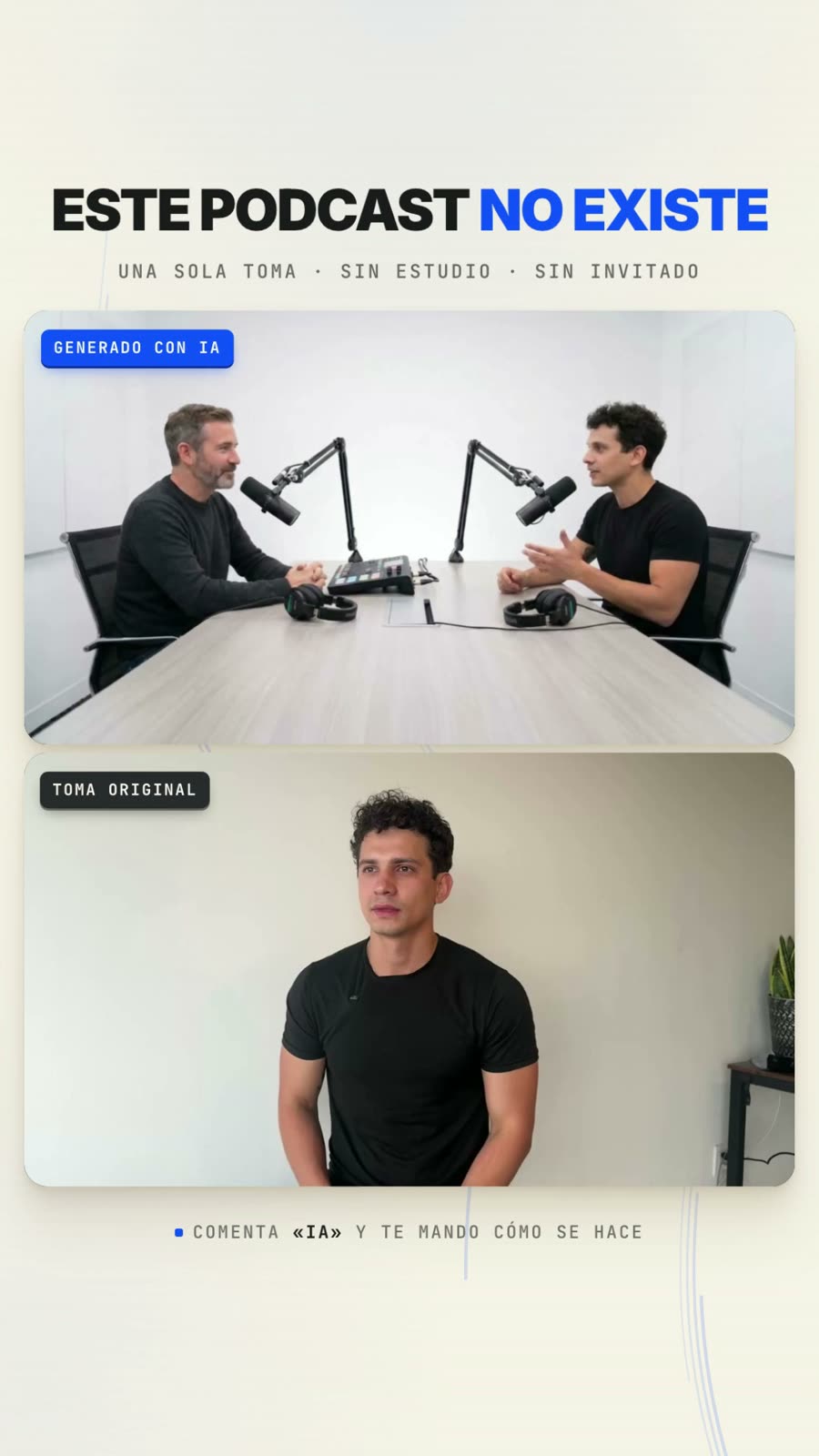
Dos personas, cinco ángulos, estudio blanco, micrófonos de brazo. Todo eso
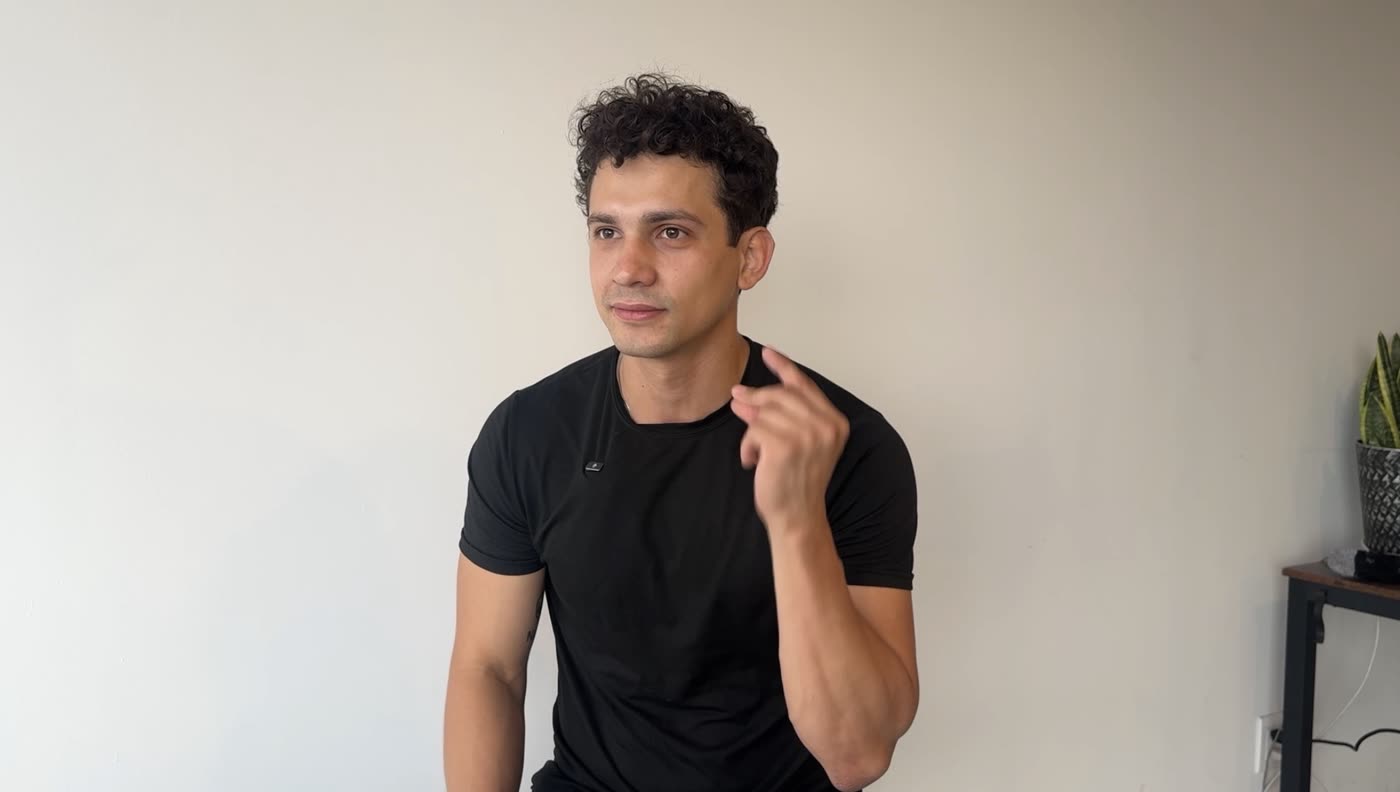
salió de un video de celular grabado en una recámara, en una sola toma, sin invitado
y sin camarógrafo. Aquí está el prompt completo con el que se generó —sin recortar, tal
cual corrió— y los cinco pasos para llegar a él: qué imagen necesitas, cómo se sacan las
otras tres y qué exactamente se le entrega al modelo.
Toma de celular. Ni estudio, ni invitado, ni camarógrafo
3
Imágenes en fondo blanco — ése es todo el set
5
Planos de un multicámara que nunca existió
17 s
Lo que el modelo generó en una sola pasada
El prompt de esta página es el que corrió de verdad,
el 8 de agosto de 2026, y las imágenes son las mismas que se le entregaron al modelo.
Nada está reconstruido para la guía.
La guía en cinco líneas
→ La materia prima es un screenshot de tu propia toma. Nada más.
→ Con ese screenshot, un editor de imágenes con IA te arma el plano general: mesa,
fondo blanco, entrevistador enfrente.
→ Del plano general —no de cero— salen los dos primeros planos. Ya tienes tus tres imágenes.
→ Al modelo le entras con tu video + las tres imágenes + el prompt, y devuelve el multicámara.
→ Lo que hace que se vea real no es el modelo: son el bloque de continuidad y la lista
de negativos, que ocupan casi un tercio del prompt.
01 — El prompt
Éste es, completo y sin recortar. Empieza por copiarlo
Está escrito en inglés a propósito: el vocabulario de cámara —wide two-shot,
locked tripod, 85mm— es el que el modelo entiende sin traducir, y los planos
van numerados como en una escaleta de rodaje de verdad. Cambia sólo tres cosas: la
descripción del anfitrión, la del entrevistador y las marcas de tiempo si tu toma no dura
17 segundos.
Lo que hace el trabajo pesado no es el estilo, son los seis bloques. Sobre todo
dos: el que dice qué referencia manda sobre qué, y el que enumera lo que no puede pasar.
Prompt completo · Seedance 2.5 · 17 s · 16:9
SEEDANCE 2.5
DURATION: 17 SECONDS
ASPECT RATIO: 16:9

REFERENCE ASSIGNMENT:
@video1 = the authoritative performance. Lock the host's exact speech, timing,
mouth movement, head motion, hand gestures and body language to this video,
frame for frame. Nothing about his delivery changes.
@image1 = exact identity of the HOST: face, curly dark hair, build, black
crew-neck t-shirt, forearm tattoo.
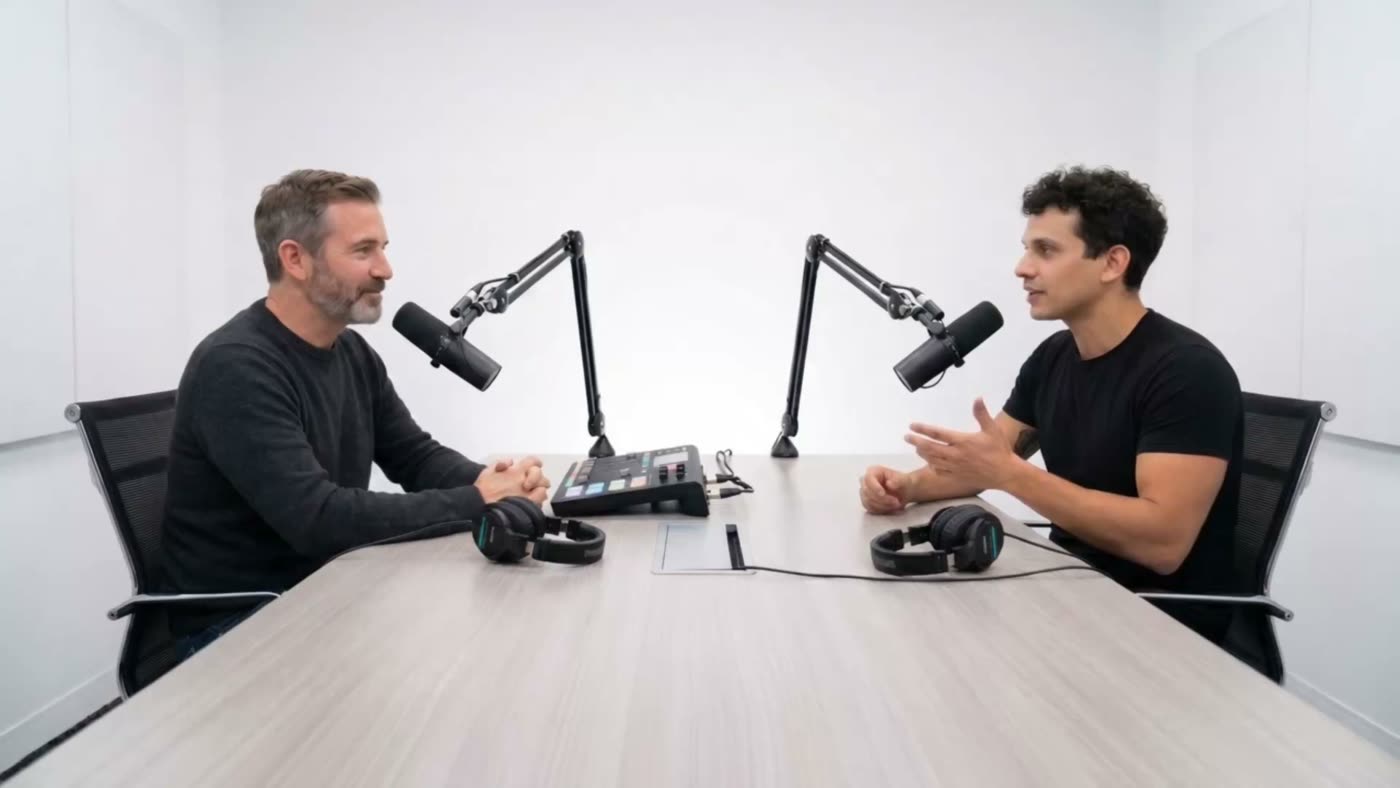
@image2 = the authoritative SET and the exact identity of the INTERVIEWER, plus
the authoritative wide two-shot composition for SHOT 01 and SHOT 05.

SET (from @image2):
White seamless studio, white walls meeting at a soft corner behind the table.
Long light wood table running across the lower frame. Two black boom-arm
broadcast microphones angled in from either side. A small black audio mixer with
coloured pads at the centre of the table, a laptop lying flat beside it, black
over-ear headphones resting on the table in front of each man, a cable running
across the surface. Black mesh Eames-style office chairs. This set is identical
in every single shot.

INTERVIEWER (from @image2):
Man in his early fifties, salt-and-pepper hair swept back, short greying beard,
no glasses, charcoal grey knit sweater. He sits at the LEFT side of the table,
in profile facing right toward the host. This is an invented character — he must
not resemble any real or recognizable public figure.

HE NEVER SPEAKS. His mouth stays closed for the entire clip. He is listening.

HOST:
The man from @image1 and @image2 — black t-shirt, curly dark hair. He sits at the
RIGHT side of the table, facing left toward the interviewer. He is the only
person who speaks.

WORLD LOCK:
Bright white podcast studio, soft even diffused key light with gentle falloff,
clean natural skin tones, no colour cast, no cinematic grade. Photorealistic:
real skin pores and texture, visible knit weave on the sweater, cotton texture on
the t-shirt, realistic specular highlights on the microphone bodies and the wood
grain of the table. Modern professional podcast production look.

CAMERA LANGUAGE:
This must read as a genuine multi-camera podcast edit, not as a moving AI shot.
Every angle is a locked-off tripod camera with only the faintest breathing drift
— no handheld shake, no push-ins, no orbits, no zooms, no dolly. All energy comes
from HARD CUTTING between static cameras, like a real podcast vision switcher.
35mm on the wide, 85mm on the singles with shallow depth of field.

SHOT 01 | 00:00 - 00:03
WIDE TWO-SHOT, exactly the composition, camera height and framing of @image2 —
symmetrical side-on view, both men in profile, microphones and mixer between
them, table across the lower frame. The host is ALREADY mid-sentence as the clip
opens — no silence, no settling in, no establishing beat. The interviewer sits
still, hands loosely clasped on the table, head angled toward the host.

SHOT 02 | 00:03 - 00:08
HARD CUT. MEDIUM SINGLE on the HOST, 85mm, locked tripod, framed from mid-chest
up, his microphone entering frame from the left, white wall softly out of focus
behind him. Three-quarter angle, speaking toward the interviewer off-frame left.
His hands move naturally as he talks, exactly as in @video1.

SHOT 03 | 00:08 - 00:10.5
HARD CUT. MEDIUM SINGLE on the INTERVIEWER, 85mm, locked tripod, framed from
mid-chest up, his microphone entering frame from the right. He listens: one slow
blink, a single small nod, eyes steady on the host off-frame right. Mouth closed
and still. Restrained, genuine attention — nothing theatrical. The host's voice
continues uninterrupted over this shot.

SHOT 04 | 00:10.5 - 00:15
HARD CUT. TIGHTER SINGLE on the HOST, 85mm — head and shoulders, closer than
SHOT 02, microphone in the lower left of frame. This is the point of the clip.
Hold here without cutting away until his final word is completely finished. Mouth
articulation perfectly synchronized to the audio of @video1.

SHOT 05 | 00:15 - 00:17
HARD CUT back to the WIDE TWO-SHOT — identical camera position and framing to
SHOT 01 and @image2. The host has finished speaking and settles slightly back
into his chair. The interviewer gives one small final nod. Two seconds of held
silence, room tone only. No dialogue.

CONTINUITY:
The interviewer stays SCREEN LEFT and the host stays SCREEN RIGHT in every angle
— their singles must respect this, the host always facing screen left, the
interviewer always facing screen right. Both men keep the same clothes, same
hair, same faces and the same seating positions throughout. Microphones,
headphones, mixer, laptop, cable and chairs never move between cuts. Every shot
is the same room, same light.

AUDIO:
Only the host's voice, taken exactly from @video1 — same voice, same language,
same intonation, same pacing. No second voice. No voice-over. No narrator. No
music, no score, no sound design. Only quiet studio room tone underneath.

NEGATIVE:
no camera movement, no handheld shake, no zoom, no push-in, no dolly, no orbit,
no slow motion, no speed ramps, no subtitles, no text, no captions, no on-screen
graphics, no logos, no watermarks, no split screen, no music, no second voice, no
interviewer dialogue, no interviewer mouth movement, no extra people, no windows,
no coloured lighting, no lens flare, no cinematic teal-orange grade, no beauty
smoothing, no glasses on the interviewer, no identity drift between shots, no
wardrobe changes, no crossing the line — screen directions never flip.
Lo que casi nadie escribe, y es lo que salva la toma: los
bloques CONTINUITY y NEGATIVE. Sin ellos el modelo mueve la
cámara, cambia la ropa entre planos, voltea la línea de mirada y le pone música. Todo
eso, junto, es lo que delata que un video es generado.
Bloque
Qué amarra
Si falta
REFERENCE ASSIGNMENT
Qué referencia manda sobre qué: el video sobre la actuación, una imagen sobre tu cara, otra sobre el set
Cara distinta
SET / WORLD LOCK
El cuarto, los objetos sobre la mesa y la luz — descritos una vez, iguales en los cinco planos
Set que muta
CAMERA LANGUAGE
Todas las cámaras fijas en tripié; la energía sale del corte, no del movimiento
Look de IA
SHOT 01–05
La escaleta con marcas de tiempo: qué plano entra en qué segundo
Un solo plano
CONTINUITY
Entrevistador siempre a la izquierda, anfitrión siempre a la derecha; nada se mueve entre cortes
Se voltea
AUDIO + NEGATIVE
Una sola voz, cero música — y la lista de todo lo que no puede aparecer
Segunda voz
02 — Cómo se hace
Cinco pasos: de un screenshot tuyo a un estudio que no existe
El orden importa más de lo que parece. Las tres imágenes que le vas a dar al modelo
tienen que salir unas de otras, no generarse por separado — es lo único que
garantiza que la ropa, la luz, la mesa y los micrófonos coincidan de un plano a otro.
1Grábate una sola toma y saca un screenshottu celular · cámara fija · sin cortes
Habla a cámara como si ya estuvieras en el podcast: sin cortes, sin moverte de
sitio y con la cámara quieta. Cuando termines, pausa el video en un frame donde se
te vea bien de frente y guarda el screenshot. Ese screenshot es la materia prima: de
ahí sale tu cara, tu pelo, tu ropa y tu complexión.
ReglaEl frame que elijas manda sobre todo
lo demás. Si sales con media cara tapada o mal iluminado, el modelo arrastra ese error
a los cinco planos y no hay prompt que lo arregle.
2Ese screenshot va a un editor de imágenes con IA, y sale el plano generalGPT Image en ChatGPT · o Nano Banana 2 en Google Gemini
Súbelo y pídele que te siente en el set. La instrucción es tan simple como suena:
«siéntalo en una mesa con fondo blanco, en un estudio de podcast, y ponle enfrente
un entrevistador». Lo que regresa es el plano general de dos personas — y ese plano
va a mandar después sobre el set completo.
OjoEl entrevistador tiene que ser un
personaje inventado. Pedir que se parezca a alguien real o reconocible es justo
lo que el prompt de la sección 01 prohíbe, y con razón.
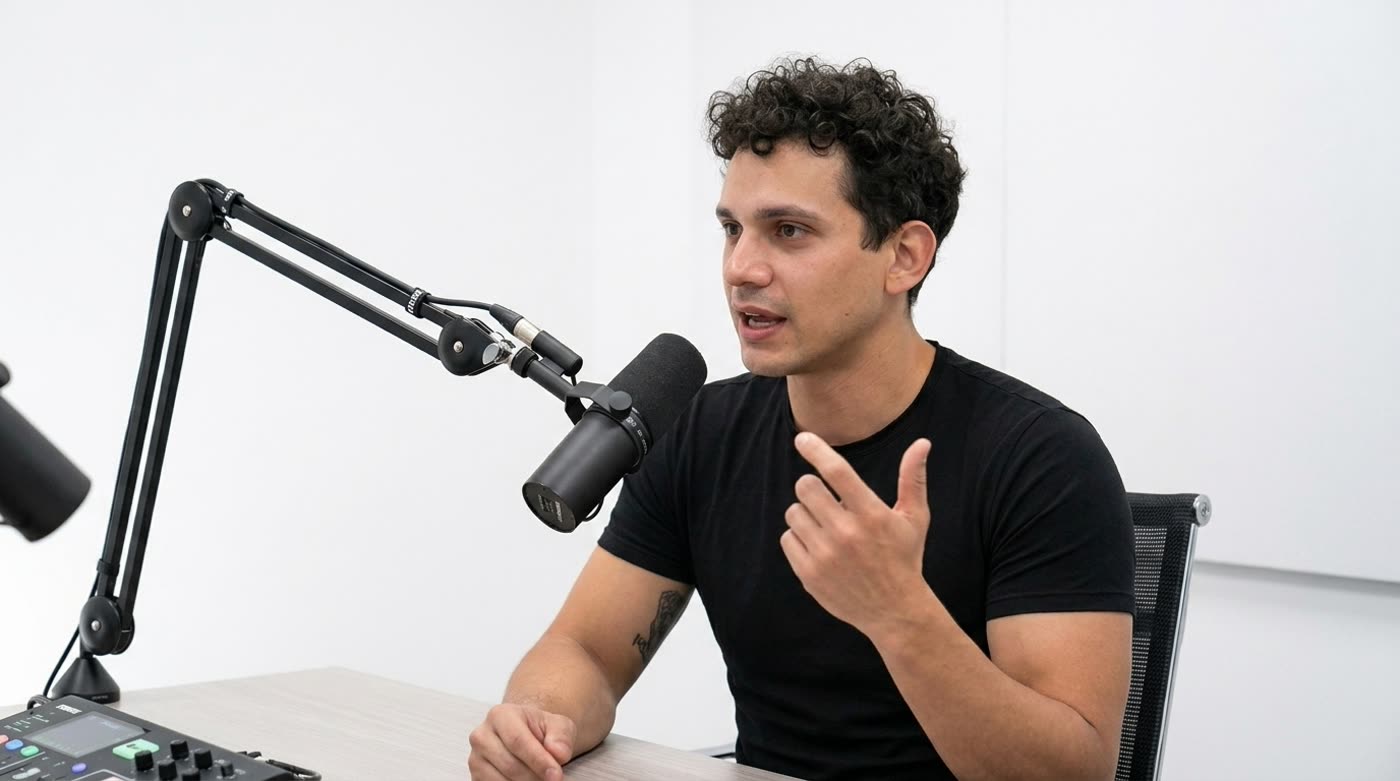
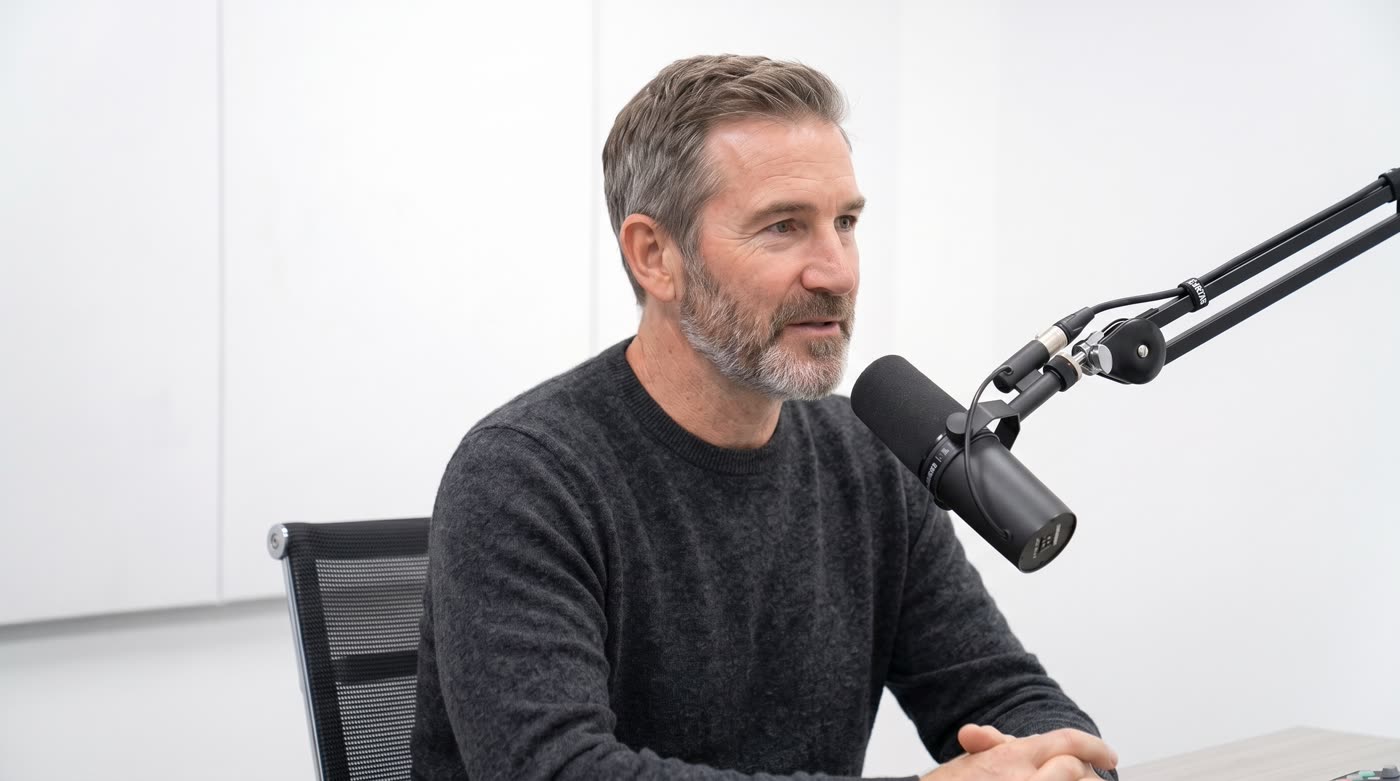
3Del plano general salen los dos primeros planosmisma herramienta · misma imagen de origen
No los generes desde cero. Vuelve a subir el plano general y pide un recorte:
primero «hazme un primer plano del de la derecha», y luego, otra vez desde la imagen
grande, «hazme un primer plano del de la izquierda». Que las tres salgan de la misma
imagen es lo que hace que todo coincida entre planos.
Ya estáCon esto tienes tus tres imágenes
en fondo blanco: el plano general y los dos primeros planos.
4Todo junto a Seedance 2.51 video + 3 imágenes + el prompt
Al modelo le entras con cuatro cosas y cada una tiene un trabajo distinto:
tu video crudo (manda sobre la voz, el ritmo y los gestos), tu primer plano
(manda sobre tu identidad), el plano general (manda sobre el set y sobre el
entrevistador) y el prompt completo. De ahí sale el multicámara de 17 segundos.
5El montaje: los dos videos corriendo a la vezel generado arriba · tu toma cruda abajo
Aquí está el detalle que hace que el reel funcione: los dos videos arrancan en el
segundo cero y corren en paralelo. Arriba el estudio, abajo tu recámara. Cuando el
generado termina, tu toma sube al centro y ahí cae el llamado a la acción. La
comparación es el contenido — sin los dos cuadros a la vez, no hay pieza.
Paso 1 — la única materia prima. Un frame de la toma de celular,
cámara fija, pared lisa. Nada de esto se retocó antes de subirlo.Paso 2 — el plano general. Mesa de madera, dos micrófonos de brazo,
mezcladora, audífonos, sillas negras. Este plano se vuelve la autoridad del set.Paso 3 — primer plano del de la derecha (el anfitrión), pedido sobre
la imagen del paso 2. Misma ropa, misma luz, mismo micrófono.Paso 3 — primer plano del de la izquierda (el entrevistador),
pedido otra vez sobre la imagen grande, no sobre el primer plano anterior.
Paso 5 — el montaje. Los dos videos en el segundo cero, uno encima
del otro. Es el frame que se ve en la portada del reel.
03 — La letra chica
Lo que separa un multicámara creíble de un video que se siente raro
Ninguna de las tres cosas de abajo tiene que ver con la calidad del modelo. Las tres se
ganan o se pierden en el texto del prompt, y las tres son las que la gente nota sin
saber por qué.
Con pedirle «un podcast» ya saleEl prompt que corrió tiene casi un tercio de su texto en
negativos: sin movimiento de cámara, sin zoom, sin subtítulos, sin música, sin
segunda voz, sin que el entrevistador abra la boca. Lo que NO quieres pesa tanto como
lo que quieres, y es la parte que casi nadie escribe.Bloque NEGATIVE · sección 01 de esta guía
El invitado puede ser quien seaEl prompt lo dice literal: es un personaje inventado y no debe
parecerse a ninguna persona real o reconocible. No es un capricho estético — es la
línea entre un recurso creativo y un problema que no quieres.Bloque INTERVIEWER · sección 01 de esta guía
La voz la pone el modeloNo: la voz sale exacta de tu video, y el prompt tiene que
decirlo tres veces —same voice, same intonation, same pacing— más «no second
voice, no narrator». Si no lo amarras, el modelo se inventa un segundo hablante y
ahí se cae todo.Bloque AUDIO · sección 01 de esta guía
Con que se parezca, bastaEl error que más delata no es la cara: es la línea de mirada.
Si en un plano el entrevistador queda a la derecha y en el siguiente a la izquierda, el
cerebro lo lee como falso antes de saber por qué. Por eso el prompt cierra con
«no crossing the line — screen directions never flip».Bloque CONTINUITY · sección 01 de esta guía
Y una regla que no es técnica
Esto funciona como contenido porque se enseña el antes y el después. El gancho
del reel es la comparación, no el engaño: arriba el estudio que no existe, abajo la
recámara donde de verdad se grabó. Presentarlo como material real es otra cosa, y ahí
deja de ser un recurso creativo.
04 — El filtro
Para quién sí, y para quién todavía no
Te conviene si…
Ya tienes una toma tuya hablando a cámara que te gusta. Ése es el 90% del trabajo.
Quieres autoridad visual sin rentar estudio, conseguir invitado ni contratar cámara.
Vas a decir que es IA: el gancho es la comparación.
Lo que tienes que decir cabe en una idea cerrada de 15 a 20 segundos.
Puedes generar varias veces — la primera casi nunca es la buena.
Todavía no, si…
Quieres hacerlo pasar por real ante clientes o audiencia.
Necesitas meter a una persona real y reconocible como invitado.
Tu toma tiene cortes, cambios de encuadre o cámara en mano: el modelo necesita una toma continua y fija.
Buscas una conversación de verdad: aquí habla uno y el otro escucha.
Esperas que salga a la primera, sin revisar plano por plano.
05 — De dónde salió esto
Material propio, sin reconstruir
El prompt — archivo original, corrido en Seedance 2.5Alex Sepúlveda · 8 ago 2026Es el texto exacto que produjo el video, copiado sin editar ni recortar. Las marcas de tiempo, los nombres de las referencias y la lista de negativos están tal cual
Las imágenes de los pasos 1 y 3 — material del propio procesoarchivos originales · 8 ago 2026El screenshot de la toma cruda y los dos primeros planos son los archivos que se le entregaron al modelo, sin retoque
Seedance 2.5 — ByteDance Seedguía hermana: «Seedance 2.5, una toma fija, todos los ángulos»Ahí están los endpoints, los límites de archivo, el precio real y la estructura general de prompt. Esta guía no los repite: se concentra en la receta del podcast
Nota de métodoUna aclaración sobre la imagen del paso 2. El plano general que se muestra está
extraído del primer frame del video generado, no del archivo de referencia original.
Son visualmente lo mismo por diseño —el prompt le pide al modelo reproducir esa composición
exacta en el plano 01 y volver a ella en el 05— pero conviene decirlo en vez de dejarlo
pasar por la imagen de origen.
Las otras cuatro imágenes sí son los archivos originales: el screenshot de la toma cruda,
los dos primeros planos y un frame del reel ya montado. Ninguna tiene retoque y ninguna es
de banco.
Lo que esta guía no te puede prometer es que el resultado salga igual. Los modelos
generativos no son deterministas: el mismo prompt, el mismo día y con las mismas imágenes
devuelve tomas distintas. Lo que sí se repite es la estructura — y ésa es la parte que se
copia.
Sotai no está afiliada a ByteDance, Seedance, Dreamina, Google ni OpenAI. Esta guía es
independiente y gratuita.
¿Y si en vez de un video, fuera tu contenido completo?
Lo que acabas de leer es una receta suelta: sirve para una pieza. Lo que de verdad mueve
un negocio es el sistema alrededor — que las ideas, los guiones, los videos y las respuestas
a quien comenta se muevan solos, cada semana, sin que tú estés empujando. En Sotai armamos
justo eso, a la medida de tu giro. Escríbenos, cuéntanos qué haces y en cinco minutos te
decimos si te conviene o si con esta guía ya la hiciste.